

In today’s fast-paced digital economy, businesses are under constant pressure to improve productivity, reduce operational costs, and deliver better customer experiences. Yet many organizations still rely on manual document processing, which slows workflows, increases errors, and limits scalability.
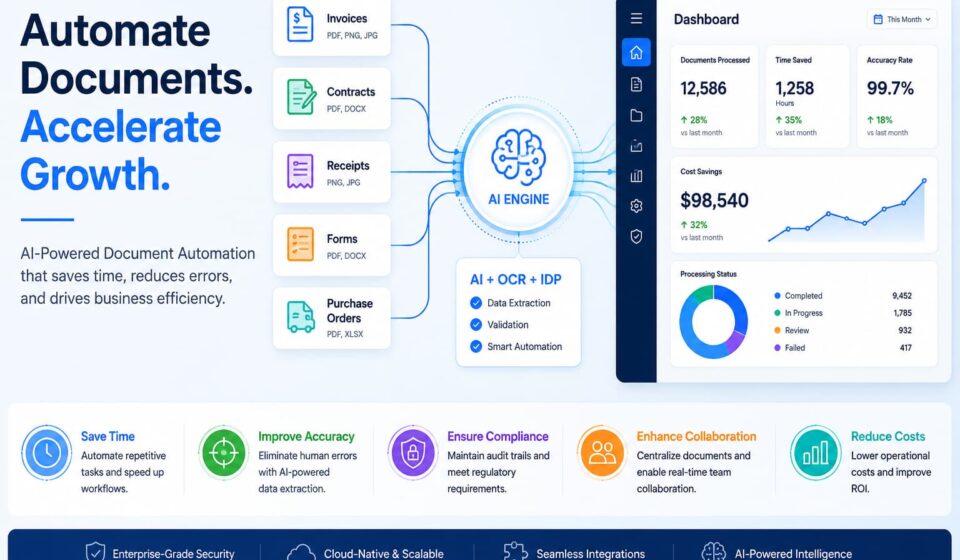
Document automation software has emerged as a powerful solution for modern businesses. By leveraging Artificial Intelligence (AI), Optical Character Recognition (OCR), and Intelligent Document Processing (IDP), organizations can automate repetitive document-related tasks, improve accuracy, and accelerate business operations.
According to industry reports, organizations implementing automation technologies often experience significant improvements in processing speed, accuracy, and operational efficiency. As digital transformation becomes a competitive necessity, document automation is no longer a luxury—it’s a strategic advantage.
What Is Document Automation Software?
Document automation software is a technology solution that automatically captures, extracts, processes, validates, and organizes information from business documents. Instead of manually entering data from invoices, contracts, purchase orders, forms, receipts, and compliance documents, businesses can automate these workflows using AI-powered systems.
Modern document automation platforms combine several technologies, including:
- Artificial Intelligence (AI)
- Machine Learning (ML)
- Optical Character Recognition (OCR)
- Intelligent Document Processing (IDP)
- Workflow Automation Engines
These technologies work together to transform unstructured documents into actionable business data.
The software can seamlessly integrate with:
- ERP systems
- CRM platforms
- Accounting software
- HR management tools
- Cloud storage platforms
This creates a centralized, automated ecosystem that improves efficiency across departments.
Read More: Why Choose Professional Moving Services in Norfolk VA for a Stress-Free Move
Why Manual Document Processing Is Holding Businesses Back
Many organizations underestimate the hidden costs of manual document handling. Employees often spend hours searching for files, entering data, correcting errors, and routing documents for approval.
Common challenges include:
- Slow processing times
- Data entry mistakes
- Lost or misplaced documents
- Compliance risks
- Limited visibility into workflows
- High labor costs
- Delayed customer service
As businesses grow, these inefficiencies become more expensive and difficult to manage. Automation eliminates these bottlenecks and creates a more streamlined workflow.
Key Benefits of Document Automation Software
1. Significant Time and Cost Savings
One of the biggest advantages of document automation is the reduction in manual work.
Tasks that previously required hours of employee effort can be completed in minutes through automated workflows. Businesses can process thousands of documents without increasing staffing costs.
Benefits include:
- Reduced administrative workload
- Lower operational expenses
- Faster document turnaround times
- Improved workforce productivity
- Better resource allocation
Organizations often achieve a faster return on investment by eliminating repetitive tasks and increasing efficiency.
2. Improved Accuracy and Reduced Human Errors
Manual data entry inevitably leads to mistakes. Even small errors can result in payment delays, compliance violations, customer dissatisfaction, or financial losses.
AI-powered document automation software:
- Extracts data with high accuracy
- Validates information automatically
- Detects inconsistencies in real time
- Reduces duplicate entries
- Improves data quality
This enhanced accuracy helps businesses make better decisions based on reliable information.
3. Stronger Compliance and Data Security
Regulatory compliance is essential for industries such as healthcare, finance, insurance, and legal services.
Modern document automation platforms provide:
- End-to-end encryption
- Role-based access controls
- Automated audit trails
- Secure document storage
- Compliance monitoring
These capabilities help organizations comply with regulations such as GDPR, HIPAA, SOC 2, and industry-specific requirements while minimizing security risks.
4. Enhanced Team Collaboration
Remote and hybrid work environments require seamless access to information.
Document automation software centralizes documents and enables:
- Real-time collaboration
- Faster approvals
- Instant document retrieval
- Version control
- Cross-department communication
Employees can work more efficiently without wasting time searching for files or waiting for approvals.
5. Scalability for Business Growth
As document volumes increase, manual processes become difficult to maintain.
Scalable automation solutions allow businesses to:
- Handle growing workloads
- Process documents faster
- Expand operations efficiently
- Maintain service quality
- Reduce hiring pressures
This flexibility supports long-term growth without creating operational bottlenecks.
6. Better Customer Experience
Customers expect faster responses and seamless service.
Automated document workflows help businesses:
- Process requests quickly
- Accelerate approvals
- Reduce service delays
- Improve communication
- Deliver consistent experiences
Faster processing leads to greater customer satisfaction and loyalty.
How AI and OCR Improve Document Processing
Modern document automation software relies heavily on AI and OCR technology.
OCR (Optical Character Recognition)
OCR converts printed or handwritten text into machine-readable data.
Examples include:
- Invoice scanning
- Receipt processing
- Form digitization
- Contract extraction
AI-Powered Intelligent Document Processing (IDP)
AI takes automation further by understanding document context, identifying patterns, and extracting critical information automatically.
Capabilities include:
- Data classification
- Smart document routing
- Fraud detection
- Predictive analytics
- Automated validation
Together, AI and OCR create highly efficient, intelligent workflows that reduce manual intervention.
Real-World Applications Across Industries
Finance and Accounting
Businesses automate:
- Invoice processing
- Expense management
- Tax documentation
- Accounts payable workflows
Healthcare
Healthcare organizations use automation for:
- Patient records
- Insurance claims
- Medical forms
- Compliance documentation
Logistics and Supply Chain
Automation simplifies:
- Shipping documents
- Bills of lading
- Inventory records
- Customs paperwork
Legal Services
Law firms automate:
- Contract management
- Case files
- Client onboarding
- Compliance reviews
Human Resources
HR departments streamline:
- Employee onboarding
- Payroll documentation
- Performance records
- Benefits administration
ROI of Document Automation
Businesses investing in document automation often see measurable returns through:
- Reduced processing costs
- Increased productivity
- Improved compliance
- Faster decision-making
- Lower error rates
- Enhanced customer satisfaction
The return on investment becomes particularly significant for organizations handling large document volumes.
How to Choose the Best Document Automation Software
When evaluating document automation solutions, consider the following factors:
Ease of Integration
Choose software that integrates seamlessly with your existing technology stack, including ERP, CRM, accounting, and cloud platforms.
AI and OCR Accuracy
Look for solutions that offer advanced AI-powered data extraction and high OCR accuracy.
Scalability
Select a platform capable of supporting future growth and increasing document volumes.
Security and Compliance
Ensure the software includes encryption, access controls, audit trails, and regulatory compliance support.
Workflow Customization
Your business processes are unique. The software should allow custom workflows, approval chains, and automation rules.
User Experience
A user-friendly interface accelerates adoption and reduces training costs.
Solutions such as Docsumo offer advanced AI-powered document processing, strong integrations, enterprise-grade security, and scalable automation capabilities, making them a popular choice for businesses seeking operational efficiency.
Frequently Asked Questions
What is document automation software?
Document automation software uses AI, OCR, and workflow automation to process, manage, and organize business documents automatically.
How does document automation improve productivity?
It eliminates manual data entry, speeds up document processing, reduces errors, and allows employees to focus on strategic tasks.
Is document automation suitable for small businesses?
Yes. Many cloud-based solutions offer affordable and scalable options for small and medium-sized businesses.
What types of documents can be automated?
Invoices, contracts, receipts, forms, purchase orders, compliance reports, employee records, and many other document types.
Is document automation secure?
Modern platforms use encryption, audit logs, access controls, and compliance features to protect sensitive business data.
Conclusion
Document automation software is transforming the way organizations manage information. By eliminating repetitive manual tasks, improving data accuracy, strengthening compliance, and enhancing collaboration, businesses can achieve significant gains in productivity and operational efficiency.
Whether you’re processing invoices, contracts, healthcare records, or logistics documents, automation provides the speed, accuracy, and scalability needed to remain competitive in today’s digital landscape.
Organizations that embrace AI-powered document automation are better positioned to reduce costs, improve customer experiences, and drive sustainable business growth in the years ahead.